
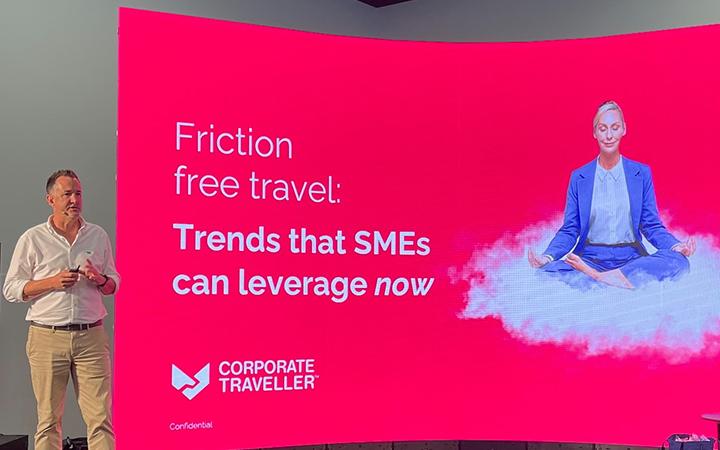
Corporate Traveller reveals four key SME travel trends to get ahead in 2026
Speaking at FACTS 2025, Tom Walley, Australia-based Global Managing Director of Corporate Traveller, outlined how SME travel has evolved from simple point-to-point bookings to complex, multi-sector journeys that look just like big corporate programs, but with way fewer resources.
Small and medium enterprises (SMEs) are completely rethinking how they approach corporate travel in 2026, putting employee performance and competitive edge ahead of traditional penny-pinching.
Four key trends are driving this shift:
- Premium economy bookings up 35 per cent as companies realise rest drives performance
- SMEs ditching separate systems to eliminate reconciliation headaches and stop 8-12% spending leaks
- 75 per cent of SME employees now blend business with leisure travel
- Companies choosing technology that boosts, rather than replaces, human expertise
"Today's SMEs face the same travel pressures as big corporates – global routes, multi-stop trips, sky-high expectations for smooth journeys," said Walley.
"The difference is they have fewer resources to manage complexity. This makes friction-free travel with a travel management company on your side a real competitive advantage."
Premium cabins become a productivity investment
Premium economy bookings have jumped 35 per cent year-on-year as SMEs continue to realise that employee rest directly impacts business results.
Research from the past year reveals that travel comfort has a direct link to performance, with 67 per cent of business travellers experiencing productivity impacts due to cramped seating and reduced flexibility. The connection is even stronger for senior management (68 per cent) and C-level executives (81 per cent).
"Companies are ditching the cheapest-fare approach – especially on long-haul" Walley explained.
"They've worked out that a well-rested employee in premium economy delivers much better outcomes than an exhausted one in economy. Productivity has become the new reason to upgrade."
Travel and expense integration becomes competitive necessity
SMEs are waking up to the need for integrated travel and expense platforms in 2026, after discovering that old-school reconciliation eats up 30% of finance teams' time, while spending leaks cost them 8-12% through dodgy purchases and manual stuff-ups.
The shift towards combined systems will kill the juggling act between separate booking and expense platforms. SMEs can ditch reconciliation nightmares and stop spending leaks – creating friction-free experiences from booking right through to travellers getting their money back.
This trend shows SMEs are finally getting it: smooth travel needs smooth money management too.
Three in four now mix business with pleasure
Flight Centre Corporate's 2025 State of the Market survey shows that three-quarters of SME customers report that employees add leisure to business trips, with innovative companies adapting policies to support the trend.
"Clever SMEs are using bleisure to cut employee fatigue and boost wellbeing. We’ve even observed families travelling with the employees to tack on a holiday at the beginning or end of a trip.
"Rather than fighting this trend, they're using it as a talent retention and employee satisfaction tool."
AI boosts human service instead of replacing it
While others debate robots versus people, we know our customers want AI for smart logistics combined with human expertise for everything else.
"At Corporate Traveller, we say 'automate the ordinary so our people can deliver the extraordinary.'"
"AI handles the routine stuff brilliantly, but when your flight gets cancelled at midnight in Bangkok, you want a real person who actually cares about getting you home."
You may also be interested in...


