Your travel management company selection criteria checklist
Choosing a travel management company (TMC) can feel a little like speed dating. Every provider puts its best foot forward with polished websites and slick sales decks. The tricky part is working out who can actually deliver once the bookings, changes, approvals, and late-night travel dramas start rolling in.
That's why your TMC selection criteria matter. Whether you're choosing a provider for the first time or reviewing your current setup, knowing what to look for helps you see past the sales pitch. This guide walks you through how to evaluate a TMC across service, technology, pricing, and reporting, slection criteria matter. Whether you're choosing a provider for the first time or reviewing your current setup, knowing what to look for helps you see past the sales pitch. This guide walks you through how to evaluate a TMC across service, technology, pricing, and reporting, so you find the right match for your business.
Contents
- What is a TMC?
- Why does choosing the right TMC matter?
- What should you look for in a TMC?
- How do you evaluate a TMC's service model and account management?
- What technology and integration capabilities should a TMC offer?
- How do TMC pricing models and fee structures compare?
- What customer support should a TMC provide?
- What compliance and reporting features should a TMC provide?
- Should you choose managed or unmanaged travel?
- What content and supplier access should a TMC provide?
- How do you know whether a TMC is the right cultural fit for your business?
- How do you shortlist and compare TMCs?
- Ready to evaluate your options?
- Frequently asked questions
What is a TMC?
A TMC handles business travel bookings, policy compliance, spend visibility, and traveller support. Providers range from global enterprise operators to SME-focused specialists, so the right one depends on your business size, travel volume, and how hands on you want to be.

Unlike a consumer travel agency, a TMC is designed around business travel. Rather than simply booking trips, they help:
- enforce travel policies
- improve visibility over spend
- provide reporting and analysis
- support duty of care responsibilities
And more. They don't all work the same way. Some offer self-serve booking tools with minimal support. Others give you a dedicated travel manager who knows your business and helps proactively manage your travel program.
Why does choosing the right TMC matter?
The right TMC gives you policy compliance, spend visibility, traveller support, and time back in your day. The wrong one adds cost, friction, and admin. For a growing SME, that difference shows up in your budget and your ability to scale travel without scaling headcount.
The impact of picking the wrong TMC is often felt long before something goes seriously wrong. Travellers book outside policy because the booking tool is clunky or confusing. Finance spends far too many hours piecing together invoices and reconciling travel expenses across multiple suppliers. And when a 10 pm flight cancellation hits with no out-of-hours support, your traveller is stuck.
More travellers and more bookings in a growing business mean more room for risk. Choosing a TMC that can manage your business travel now and scale with you sets you up with the right foundations.
Most of these slip-ups aren’t deliberate. Clear processes and easy-to-use tools make it much simpler for travellers to get expenses right the first time.

What should you look for in a TMC?
Strong TMC selection criteria cover eight key areas:
- service model and account management
- technology and integration capabilities
- pricing models and fee structures
- customer support
- compliance and reporting features
- managed vs unmanaged travel approach
- content and supplier access
- and cultural fit for your business size and travel type
Think of this as your TMC evaluation checklist. The sections below unpack each area so you can tell what's genuinely useful from what just sounds good in a pitch deck.
Not every criterion carries equal weight. A business with 20 travellers flying domestically has very different priorities from one with 200 crossing the Asia Pacific region. Work out what matters most to you first, then use that as your scorecard.
How do you evaluate a TMC's service model and account management?
Evaluate a TMC's service model by looking past the promises and finding out who’s actually there when you need help.
Ask the practical questions: Who handles urgent changes? Who steps in when your usual contact is away? Does account management mean regular advice and reviews, or just a report each quarter?
What technology and integration capabilities should a TMC offer?
A TMC should offer an easy-to-use platform that integrates with the systems your business already uses.
Test the booking experience first. Can travellers find suitable options, make changes, request approvals, and manage trips on the go without getting stuck? A clunky platform will make people book elsewhere.
Then check how it connects with your finance, HR, and expense systems. Good integrations reduce double handling and give your team a much clearer view of spend.
How do TMC pricing models and fee structures compare?
TMC pricing can include service fees, management fees, plus additional fees beyond the basics such as after-hours service fees or change fees.
Ask what's included, what costs more, and whether charges shift for online bookings, travel-manager-assisted bookings, amendments, or cancellations. Check how fees are reported too, so nothing surprises you mid-trip.
The cheapest option on paper may not be the cheapest to run. Poor support, manual reconciliation, extra admin load on your team, and bookings made outside the platform can quickly wipe out any savings.
Understand how TMCs charge, what fees to look for, and how to compare providers fairly so you aren’t caught off guard.
What customer support should a TMC provide?
A TMC should provide fast, reliable support whenever your travellers need it, whether they're booking a trip or dealing with unexpected hiccups on the road.
Ask what happens when a flight is cancelled, or someone needs to change their itinerary at the last minute. Is support available 24/7? Will your travellers speak to a real person? Is support local or offshore?
What compliance and reporting features should a TMC provide?
A TMC should help keep bookings within policy and give your business a clear view of where travel spend is going.
Look at how the platform handles approvals and out-of-policy bookings. Does it flag issues before someone books, or only after the money has been spent?
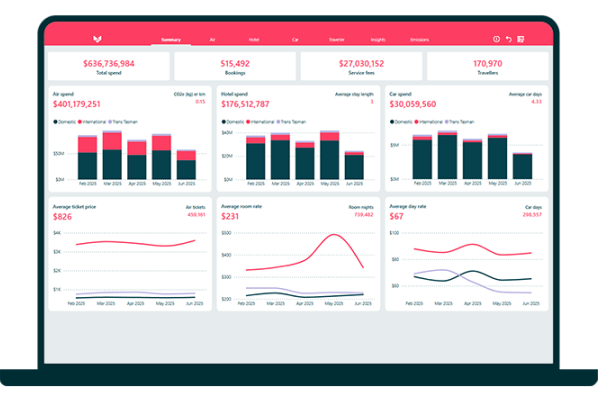
Reporting matters too. You should be able to see spend by team, traveller, project, or supplier without pulling data together manually. The useful reports are the ones that show where costs are creeping up and where behaviour needs to change.
Should you choose managed or unmanaged travel?
Managed travel is business travel supported by a TMC. Unmanaged travel leaves bookings to an executive assistant, travel arranger, or the travellers themselves.
It's also not always an either-or decision. Many growing businesses use a hybrid approach, managing some travel through a TMC while allowing flexibility in other situations. If you're evaluating TMCs for the first time, it's worth discussing what model best suits your business rather than assuming you have to fit into one category.
What content and supplier access should a TMC provide?
A TMC should give travellers a broad choice of flights, accommodation, and ground transport without sending them to other websites to hunt for better options.
Ask where the provider sources its travel content and whether travellers can access major airlines and hotel chains through the same platform. A limited range means people are more likely to jump on Google to book, making it much harder to track spend and stay within policy.
Ask about negotiated business rates and exclusive supplier deals too. Better content gives travellers the right options at the right price, all in one place.
How do you know whether a TMC is the right cultural fit for your business?
Cultural fit matters because your TMC will be closely involved in how your people travel and how problems get solved.
Do they communicate clearly? Understand how your team works? Do they work with similar businesses to yours? Feel like a genuine partner rather than another help desk?
Matthew Haymes, Director of Haymes Paint put it simply:
"As long as our Travel Manager remains at Corporate Traveller, I'm there for life. When you find a relationship that is that special and that unique, you just don't walk away from it."
How do you shortlist and compare TMCs?
Comparing TMCs can get overwhelming fast. Follow these five steps, and you’ll be well on your way to finding the right fit.

-
1. Define your requirements.
Start with the basics. How often do your people travel? Is it mostly domestic or international? What level of support are you looking for?
-
2. Build a shortlist.
Look for TMCs with experience supporting businesses like yours. Ask peers for recommendations and look for customer stories from similar businesses.
-
3. Issue an RFP.
Provide each TMC with the same brief to compare pricing, service, tech and support on equal terms.
-
4. Run the same demo.
Give each provider the same booking scenarios and see how their platform performs. Check references. Ask to speak with customers that look like your business, not just the provider's biggest or longest-standing clients.
Switching TMCs takes time, so a little extra effort now can save a whole lot of frustration later.

Ready to evaluate your options?
No TMC will tick every box perfectly, and that’s okay. The goal is to find the provider that performs best where it matters most to your business.Use the eight criteria above to compare your shortlist, weigh up the trade-offs, and focus on what will make the biggest difference day to day for everyone involved.
See how Corporate Traveller works for growing businesses and why switching could be the best move you make this year.
Frequently asked questions (FAQs): Travel management companies
Here are some of the most common things businesses ask us when weighing up their options.
-
What's the difference between a TMC and a travel agency?
A travel agency helps you book travel. A travel management company (TMC) helps you manage it. Along with flights and accommodation, a TMC provides travel policy support, reporting, duty of care, supplier negotiations, traveller assistance, and technology designed specifically for business travel.
-
What questions should I ask a TMC during a demo?
Focus on the things you'll use every day. Ask how bookings, approvals, and changes are managed, what happens when travel is disrupted, how the platform integrates with your existing systems, and what reporting you'll have access to. It's also worth asking who will support your account and whether you'll have a dedicated Travel Manager or a shared service team.
-
Who is Corporate Traveller best suited for?
We’re built for SMEs and mid-market businesses that want expert guidance, simplified technology, and tangible savings — all delivered by a dedicated Travel Manager who knows your business inside out.
-
How do I switch from my current travel provider?
Switching is straightforward. Corporate Traveller's onboarding team manages the transition from your existing provider, and most customers are travel-ready in as little as two days!
Your dedicated Travel Manager sets up your travel policy, traveller profiles, and booking platform, then supports you through a hypercare period after go-live.
-
How does Corporate Traveller save my business money?
Savings come from every angle. Expect up to 30% off airfare, an average of $140 saved per hotel booking, and exclusive Breakfast Plus Program rates across 24,500+ properties.
Your Travel Manager negotiates waivers and upgrades on your behalf, while CT Pay's consolidated billing gives your team 10+ hours back each month on reconciliation.
The ROI Dashboard shows every dollar returned (including time saved), traced to real bookings.
-
What kind of support can I get with Corporate Traveller?
Your dedicated Travel Manager is your main point of contact, backed by customer success support and a 24/7 emergency team. During business hours, your Travel Manager handles bookings, changes, and policy questions.
If something goes wrong outside business hours, our Australia-based emergency team is just a phone call away.